
Choosing the right mouse trap is not simply a matter of selecting the strongest or cheapest model. You need to match the trap type to the target rodent, the application environment, the required service frequency, local regulations, and your customer’s preferred control method. If you distribute pest control products, manage a retail range, or operate a professional pest management business, the right product mix can improve control results while reducing complaints, replacement costs, and inventory risk.
This mouse trap buying guide explains the risks created by rodent infestations, the advantages of traps, and the differences between rat bait stations, multiple mouse traps, snap traps, and cage traps. You will also see four representative Paiste products that can help you build a practical rodent control range for different markets.
Why Rodent Infestations Require Fast Action
Rats and mice can create health, property, inventory, and reputational risks. They often move through food storage areas, warehouses, restaurants, farms, supermarkets, offices, and residential buildings while searching for food, water, and shelter.
Health and Food-Contamination Risks
Rodents may contaminate surfaces and stored goods with droppings, urine, saliva, nesting material, and hair. The U.S. Centers for Disease Control and Prevention explains that rodents can spread diseases directly or indirectly and that contaminated rodent waste can expose people through contact, food, or airborne particles.
Therefore, if you supply food plants, restaurants, supermarkets, farms, schools, or healthcare-related facilities, you should treat rodent monitoring as part of a broader hygiene and risk-management program.
Damage to Buildings, Cables, and Inventory
Rats and mice gnaw continuously. As a result, they may damage packaging, insulation, plastic components, wooden structures, and electrical wiring. Even when the physical loss appears small, contaminated cartons or chewed packaging can force a warehouse or retailer to reject an entire batch of goods.
Business and Reputation Risks
Visible rodents, droppings, or damaged packages can quickly reduce customer confidence. In commercial environments, a rodent complaint may also trigger extra inspections, urgent pest control costs, product disposal, or disruption to normal operations. Consequently, you should detect activity early and select a control method that your team can inspect, service, and document consistently.
Why Use Mouse Traps in a Rodent Control Program?
Trapping gives you a targeted and measurable method of rodent control. The U.S. Environmental Protection Agency’s Integrated Pest Management guidance identifies mechanical control, including trapping, as one of the targeted options that can be used after monitoring and prevention.
When you combine traps with sanitation, exclusion, and routine inspection, you can build a more complete Integrated Pest Management program.
- Targeted control: You place traps where you have observed droppings, gnaw marks, tracks, or other signs of rodent activity.
- Visible monitoring: Many trap designs let you confirm whether the device has captured a rodent or needs servicing.
- Multiple control options: You can choose lethal, multi-catch, enclosed bait, or live-capture solutions according to the site and customer requirements.
- Reusable product choices: Durable plastic and metal traps can support repeated servicing when users clean and maintain them correctly.
- Suitable for different sales channels: You can build product ranges for professional pest controllers, farms, hardware stores, supermarkets, e-commerce brands, and household markets.
- Supports documentation: Numbered trap locations and scheduled checks can help commercial users monitor activity and record servicing.
However, no single trap is ideal for every site. You should always identify the rodent, inspect the environment, remove food and water sources, seal entry points where practical, and follow the product instructions and local regulations.
How to Choose a Mouse Trap
Before you compare product prices, ask the following questions:
- Which rodent are you targeting? A small house mouse and a large rat require different entry sizes, trigger forces, and trap dimensions.
- Where will the product be used? Food facilities, outdoor perimeters, homes, warehouses, farms, and retail locations have different safety and servicing requirements.
- Do you need live capture or rapid removal? Your customer’s policy, local rules, and operational procedures will affect the right choice.
- How severe is the activity? A multi-catch trap may suit locations with repeated mouse activity, while several snap traps may support targeted placement along active runways.
- How often can the user inspect the trap? Any capture device should be checked on a regular schedule. Live-capture devices generally require especially frequent attention.
- Are children, pets, or non-target animals present? Choose secure placement and suitable enclosed products, and always follow label directions.
- What does your market expect? Distributors should consider packaging, instructions, replacement parts, material durability, private-label requirements, and target retail price.
Mouse Trap Comparison: Which Type Fits Your Application?
| Product Type | Best Suited For | Main Advantages | Representative Paiste Product |
|---|---|---|---|
| Rat Bait Station | Outdoor perimeters, warehouses, commercial sites, professional servicing | Protects bait or an internal trap from weather and unauthorized access; supports organized monitoring | GKMT-16 |
| Multiple Mouse Trap | Warehouses, food-related sites, offices, retail stores, repeated mouse activity | Captures more than one mouse, reusable metal body, clear inspection window | GKMT-6 |
| Snap Trap | Targeted indoor control, homes, storage areas, professional route servicing | Fast mechanical action, compact size, simple placement, easy inventory handling | GKMT-1 |
| Cage Trap | Live-capture programs, farms, gardens, warehouses, small-animal control | Reusable alloy-steel construction, visible capture, no rodenticide required | GKAC-4 |
1. Rat Bait Station: A Secure Choice for Structured Rodent Control
A rat bait station is a lockable enclosure that holds rodent bait or, in some designs, a mechanical trap. Strictly speaking, the station itself may not capture the rodent. Instead, it protects the control material and helps you organize placement and servicing.
You may choose a bait station when your customer needs a durable product for building perimeters, warehouses, farms, waste areas, commercial properties, or professional pest control routes. A secure enclosure can help protect bait from rain, dust, and accidental movement. Nevertheless, users must select the correct bait, follow its label, comply with local rodenticide rules, and keep the station away from unauthorized access.
Representative Product: Hexagon Rat Bait Station GKMT-16
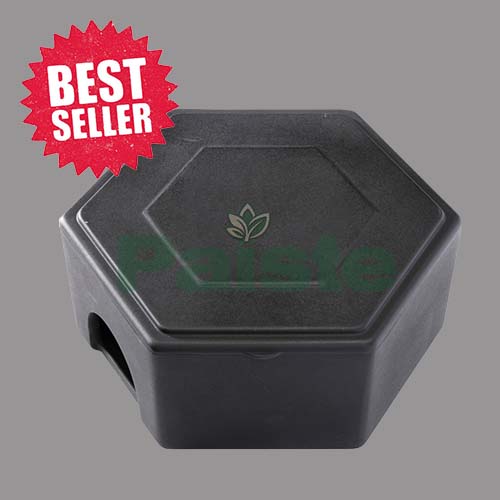
The GKMT-16 Hexagon Rat Bait Station uses a balanced hexagonal structure and provides enough internal space for practical bait placement. Its durable plastic housing makes it suitable for indoor and outdoor applications. This model is a strong choice for pest control distributors that need a distinctive, serviceable station for professional users.
2. Multiple Mouse Trap: A Practical Option for Repeated Activity
A multiple mouse trap can capture more than one mouse before the device requires resetting. Therefore, it can help in warehouses, offices, retail stores, food-related facilities, and other sites where technicians repeatedly observe mouse activity.
This type of trap is especially useful when your customer wants a reusable, non-rodenticide option with easy visual inspection. However, the user still needs a regular inspection, cleaning, and servicing schedule.
Representative Product: Clear Window Metal Live Mouse Trap GKMT-6

The GKMT-6 Clear Window Metal Live Mouse Trap combines a galvanized sheet-metal body with a transparent viewing window. Users can check the trap without opening it, while the multi-catch design supports locations with recurring mouse activity. Moreover, its reusable construction makes it suitable for professional service companies and commercial accounts.
3. Snap Trap: Compact and Direct Mechanical Control
A snap trap uses a spring-powered mechanism to capture a rat or mouse when the rodent activates the trigger. It is one of the most familiar mechanical control methods and works well when you place the correct size in an active rodent runway.
Snap traps are compact, easy to distribute, and suitable for many retail and professional channels. You can also deploy several units at once to improve coverage. Utah State University Extension advises placing snap traps with the trigger toward baseboards, particularly in dark corners where mice travel. You can review its practical guidance on the house mouse and trap placement.
Representative Product: Mouse Trap and Rat Snap Trap GKMT-1

The GKMT-1 Mouse Trap and Rat Snap Trap uses a durable plastic body and is available in sizes for different rodent-control requirements. Its compact design makes storage, packaging, placement, and replacement straightforward. As a result, it suits retailers, distributors, and pest control companies that need a familiar, easy-to-merchandise product.
4. Cage Trap: Reusable Live-Capture Equipment
A cage trap captures a rodent or other small animal inside a metal enclosure. You may select this option when a site requires live capture, visible monitoring, or a non-rodenticide control method.
Before recommending a cage trap, confirm the target species, trap dimensions, placement area, inspection schedule, and local rules for handling or releasing captured animals. The user should check the trap frequently and protect captured animals from prolonged exposure to heat, cold, or stress.
Representative Product: Metal Live Animal Cage Trap GKAC-4

The GKAC-4 Metal Live Animal Cage Trap uses an alloy-steel structure and measures approximately 16.54 × 6.69 × 6.69 inches. The reusable design suits farms, gardens, warehouses, and other sites that require a visible live-capture solution.
How to Build the Right Mouse Trap Range for Your Customers
If you serve different buyer groups, offer more than one control method. A balanced product range helps your customers choose according to the site, rodent pressure, safety requirements, and service model.
- Overseas distributors and importers: Combine bait stations, snap traps, multiple mouse traps, and cage traps to cover professional and retail demand.
- Large supermarkets and retail chains: Select clear packaging, understandable instructions, barcodes, consistent labeling, and several price levels.
- Pest control companies: Prioritize durable construction, easy inspection, fast servicing, repeat availability, and products suitable for route-based accounts.
- Food facilities and warehouses: Choose equipment that supports documented monitoring, easy cleaning, secure placement, and regular inspection.
- Farms and agricultural suppliers: Offer robust indoor and outdoor solutions for buildings, storage areas, livestock facilities, and perimeter control.
- Private-label brands: Plan logo placement, packaging language, instructions, carton marks, target retail presentation, and order quantities before production.
Why Choose Paiste as Your Mouse Trap Supplier and Manufacturer?
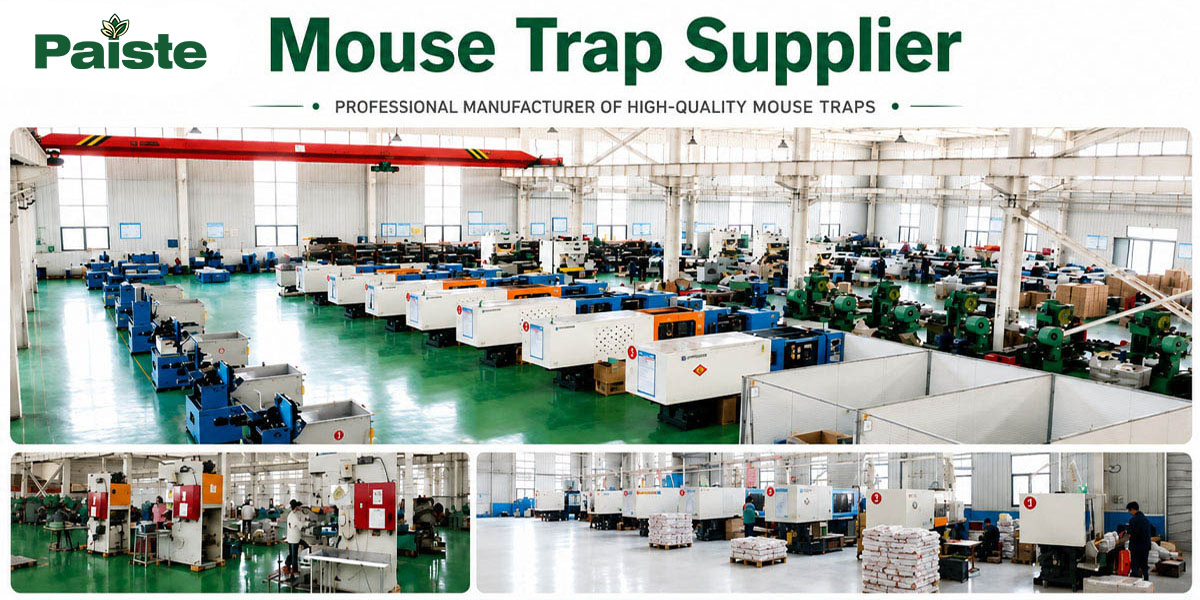
Paiste is a professional mouse trap supplier and manufacturer in China. We supply overseas distributors, importers, large supermarkets, pest control companies, retailers, agricultural suppliers, and private-label brands.
When you work with a large and experienced factory, you need more than a low unit price. You need consistent specifications, controlled production, clear communication, stable repeat supply, and the ability to develop a complete product range.
Large-Scale Manufacturing Capability
Paiste combines plastic injection molding, metal stamping, forming, assembly, functional testing, and packaging operations. Therefore, you can source plastic bait stations, metal multiple traps, snap traps, cage traps, and related pest control products from one manufacturing partner.
Strict Quality Control
We inspect incoming materials, molded or stamped parts, assembly quality, trap function, appearance, labels, and packaging. In addition, we can confirm approved samples and product requirements before mass production to improve consistency across repeat orders.
OEM, ODM, and Private-Label Support
You can customize colors, logos, labels, retail boxes, instructions, barcodes, carton marks, packaging languages, and selected product specifications. If you are developing a new line, our team can also help you compare structures and select products for your target channel.
Reliable Support for Global B2B Buyers
We understand the requirements of distributors, large retailers, and professional pest control companies. Consequently, we support product selection, mixed-product discussions, sample evaluation, export packaging, production scheduling, and international shipment coordination.
Quick Answer: Which Mouse Trap Should You Choose?
- Choose a rat bait station when you need a secure, serviceable enclosure for a structured baiting or trapping program.
- Choose a multiple mouse trap when a site has repeated mouse activity and the user wants reusable multi-catch control.
- Choose a snap trap when you need compact, targeted, rapid mechanical control.
- Choose a cage trap when the customer requires live capture and can inspect the trap frequently.
The best selection depends on the target rodent, application, inspection schedule, local rules, and customer expectations. For many distributors and professional pest control companies, the strongest range includes all four types.
Frequently Asked Questions
What is the best mouse trap for commercial use?
There is no single best model for every commercial site. Multiple mouse traps work well where mice are repeatedly active, while snap traps support targeted placement. Bait stations help organize secure perimeter programs, and cage traps serve specific live-capture requirements.
What is the difference between a bait station and a mouse trap?
A mouse trap captures or kills a rodent mechanically. A bait station is a secure enclosure that normally holds rodent bait or, in some designs, an internal trap. The station helps protect the control material and organize servicing.
When should you choose a multiple mouse trap?
Choose a multiple mouse trap for warehouses, offices, retail stores, food-related sites, or other locations with repeated mouse activity. It is particularly useful when users want a reusable device that can capture more than one mouse.
Are snap traps suitable for professional pest control?
Yes. Professional users often deploy correctly sized snap traps along active rodent runways. Placement, inspection, sanitation, and exclusion all affect results.
Can Paiste customize mouse traps for private-label brands?
Yes. Paiste supports OEM and ODM projects, including custom logos, colors, labels, packaging, instructions, barcodes, and carton marks. Available options depend on the product model and order requirements.
How can you request a wholesale quotation?
Send Paiste the product models, quantities, destination country, packaging requirements, and customization needs. Our team can then recommend suitable options and prepare a factory quotation.
Contact Paiste to compare mouse trap models, request samples, or discuss an OEM/ODM rodent control product range for your market.
Need Professional Pest Control Solutions?
We supply high-quality pest control products for wholesalers, distributors, and pest control companies worldwide.