
When you need to control rats or mice around homes, warehouses, farms, restaurants, commercial buildings, or industrial facilities, choosing the right rodent control product can make your pest management program more effective.
Two common options are the Plastic Rat Bait Station and the Multi-Catch Mouse Trap. Both products are designed for rodent control, but they use two very different methods.
Plastic Rat Bait Stations provides a secure place for rodenticide bait. Rats or mice enter the station, consume the bait, and are controlled by the rodenticide.
Multi-Catch Mouse Traps, on the other hand, attracts mice into an enclosed trap using food bait or another suitable attractant. Once mice enter the trap, they are captured and contained. Depending on the trap design and local regulations, you may then remove or release the captured mice.
Therefore, the main difference is simple: a Plastic Rat Bait Station uses bait-based rodent control, while a Multi-Catch Mouse Trap uses physical capture.
What Is a Plastic Rat Bait Station?
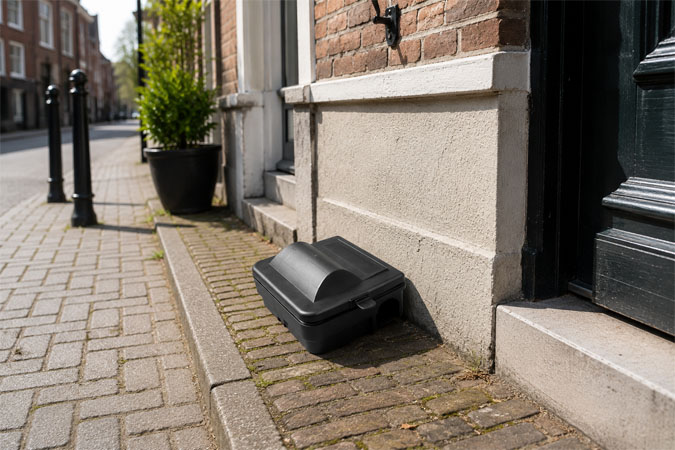
A Plastic Rat Bait Station is an enclosed box designed to hold rodenticide bait securely.
You place the bait inside the station and position it in areas where rats or mice are active. Rodents enter through the openings and consume the bait inside.
The station itself does not usually kill the rodent mechanically. Instead, it protects and contains the rodenticide while providing rodents with access to it.
Most commercial plastic rat bait stations are manufactured from durable PP or ABS plastic. Many models also feature a locking system to help prevent unauthorized access to the bait.
Because plastic offers good resistance to moisture and corrosion, you can use suitable rat bait stations in both indoor and outdoor rodent control programs.
What Is a Multi-Catch Mouse Trap?
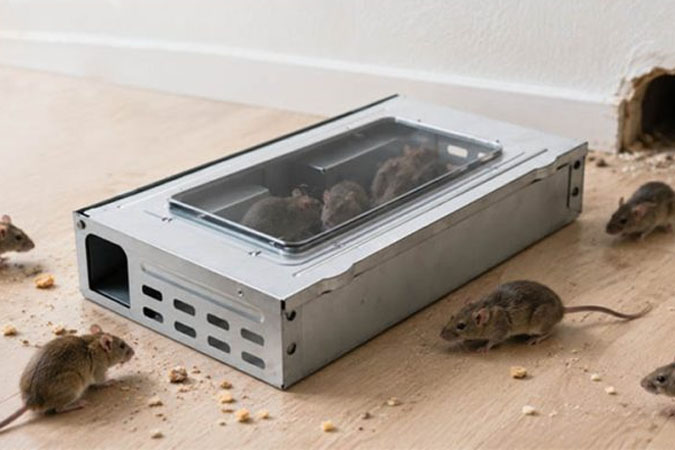
A Multi-Catch Mouse Trap uses physical capture instead of rodenticide.
You can place suitable food bait or attractants inside the trap to encourage mice to enter. Once a mouse enters through the trap mechanism, it becomes contained inside the box.
Unlike a rat bait station, a multi-catch trap does not depend on toxic bait to control mice.
Another important feature is its multi-catch capability. Depending on the design, one trap can capture several mice before you need to service it.
Multi-catch mouse traps are available in different materials and structures. Common options include galvanized steel, coated metal, plastic, and combinations of different materials.
As a result, you can choose different models according to your market, application environment, and customer requirements.
Plastic Rat Bait Station vs. Multi-Catch Mouse Trap
The two products serve the same general purpose—rodent control—but their working methods are significantly different.
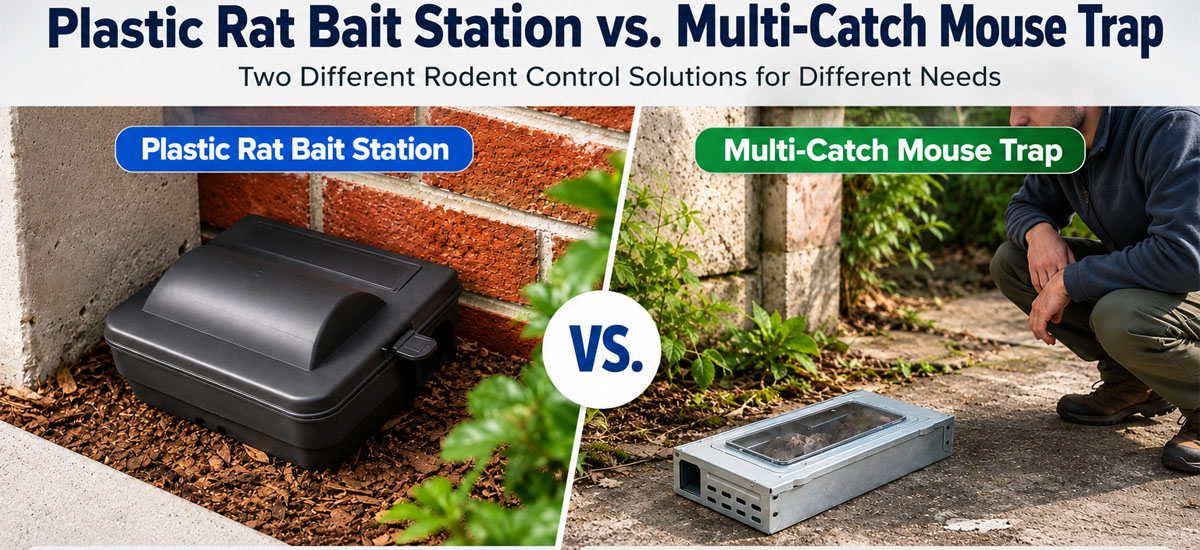
| Feature | Plastic Rat Bait Station | Multi-Catch Mouse Trap |
|---|---|---|
| Main purpose | Bait-based rodent control | Physical mouse capture |
| Control method | Rodenticide bait | Trap and contain |
| Rodenticide required | Usually yes | No |
| Typical target | Rats and mice, depending on model | Mainly mice |
| Common material | PP / ABS plastic | Metal, plastic, or combined materials |
| Reusable | Yes | Yes |
| Multi-catch function | No | Available |
| Indoor use | Yes | Yes |
| Outdoor use | Yes | Yes, depending on model |
| Monitoring method | Check bait consumption | Check captured mice |
| Main advantage | Protected bait placement | Poison-free physical capture |
Therefore, you should select the product according to the type of rodent problem and the control method you prefer.
Advantages of Plastic Rat Bait Stations
A Plastic Rat Bait Station provides several advantages for professional rodent control.
First, the enclosed structure helps protect rodenticide bait from direct exposure. Lockable designs can also help restrict access when the station is installed and used correctly.
Second, plastic materials such as PP and ABS offer good resistance to moisture and corrosion. Therefore, suitable models can perform well in both indoor and outdoor environments.
Third, bait stations help you establish fixed rodent monitoring and baiting points. Pest control technicians can inspect each station regularly, check bait consumption, and replenish bait when necessary.
Finally, plastic rat bait stations are available in different sizes and structures. You can select models for mice, rats, and different commercial applications.
Advantages of Multi-Catch Mouse Traps
A Multi-Catch Mouse Trap gives you a different way to manage mouse problems.
One of its biggest advantages is physical capture without requiring rodenticide. This makes it useful when you want a poison-free trapping method.
In addition, many multi-catch mouse traps are reusable. You can inspect, clean, reset, and continue using suitable models as part of an ongoing rodent management program.
The multi-catch design is another important advantage. Depending on the model, one trap can capture multiple mice before servicing.
This feature can be especially useful in locations with frequent mouse activity.
Multi-catch traps can also support rodent monitoring. By regularly checking the traps, you can identify active mouse areas and adjust your rodent control strategy accordingly.
When Should You Use a Plastic Rat Bait Station?
Choose a Plastic Rat Bait Station when you need a protected system for deploying rodenticide bait.
You can use suitable models in locations such as:
- Warehouses and distribution centers
- Farms and agricultural buildings
- Industrial facilities
- Commercial properties
- Residential properties
- Gardens and outdoor areas
- Building perimeters
- Storage facilities
Plastic rat bait stations are particularly useful when you need to establish multiple baiting points as part of a structured rodent control program.
However, because these stations may contain rodenticide, you should always follow the bait manufacturer’s instructions and applicable local regulations.
When Should You Use a Multi-Catch Mouse Trap?
Choose a Multi-Catch Mouse Trap when you want to physically capture mice without relying on rodenticide.
You can use suitable models in:
- Warehouses
- Shops
- Garages
- Farms
- Commercial buildings
- Residential properties
- Storage rooms
- Restaurants and food-related facilities
- Covered outdoor locations
A multi-catch trap is especially useful when you want a reusable and poison-free mouse control solution.
Depending on the model and local regulations, you may also use certain multi-catch traps for live capture.
For outdoor applications, you should select a trap with materials and construction suitable for the local environment.
Can You Use Both Products Together?
Yes. You do not necessarily need to choose only one solution.
In many rodent management programs, Plastic Rat Bait Stations and Multi-Catch Mouse Traps can work together.
For example, you can place suitable bait stations around the exterior perimeter of a warehouse while installing multi-catch mouse traps at selected indoor mouse activity points.
You can then inspect both products regularly and adjust their locations according to rodent activity.
By combining different control methods, you can create a more flexible rodent management program for different environments.
How to Choose Between the Two
Your final choice depends on your target rodent, application environment, and preferred control method.
Choose a Plastic Rat Bait Station when you:
- Need protected placement of rodenticide bait
- Want to establish permanent baiting points
- Need solutions for rats or mice
- Require indoor and outdoor rodent control
- Manage large commercial or industrial areas
Choose a Multi-Catch Mouse Trap when you:
- Prefer physical capture
- Want to avoid rodenticide
- Mainly need to control mice
- Need a reusable mouse trap
- Want to capture multiple mice with one trap
- Need to monitor mouse activity
For distributors and pest control product wholesalers, offering both product types allows you to meet a wider range of customer requirements.
Choose Paiste as Your Mouse Trap Supplier

When you source rodent control products for your business, a reliable manufacturer can help you maintain product quality, expand your product range, and build a more stable supply chain.
Paiste is a professional mouse trap manufacturer and wholesale supplier in China, supplying rodent control products to distributors, wholesalers, importers, pest control suppliers, retailers, and other B2B buyers.
You can source a wide range of products, including Plastic Rat Bait Stations, Multi-Catch Mouse Traps, Live Mouse Traps, Snap Traps, Rat Traps, Mole Traps, and other pest control products.
In addition, Paiste supports wholesale and bulk orders, OEM/ODM manufacturing, customized logos, private labeling, packaging customization, colors, and selected product specifications.
Therefore, whether your customers need bait-based rodent control or reusable physical mouse capture, you can build a more complete rodent control product range with Paiste.
FAQ
Q1. What is the difference between a Plastic Rat Bait Station and a Multi-Catch Mouse Trap?
A Plastic Rat Bait Station holds rodenticide bait for bait-based rodent control. A Multi-Catch Mouse Trap physically captures and contains mice without requiring rodenticide.
Q2. Does a Plastic Rat Bait Station kill rats by itself?
Normally, no. The station provides a protected location for rodenticide bait. The rodenticide produces the lethal effect after the rodent consumes it.
Q3. Does a Multi-Catch Mouse Trap require poison?
No. Multi-catch mouse traps use a physical trapping mechanism and do not require rodenticide.
Q4. Can a Multi-Catch Mouse Trap capture several mice?
Yes. Depending on the design, a multi-catch mouse trap can contain multiple mice before you need to service the trap.
Q5. Can both products be used indoors and outdoors?
Yes. Suitable models can be used indoors and outdoors. However, you should select the appropriate material and design according to the environment.
Q6. Which is better: a Rat Bait Station or a Multi-Catch Mouse Trap?
Neither is universally better. Choose a rat bait station when you need protected rodenticide placement. Choose a multi-catch mouse trap when you prefer physical, poison-free mouse capture.
Q7. Can distributors sell both products together?
Yes. Offering both products helps you cover different customer needs, from professional baiting programs to reusable physical trapping.
Q8. Is Paiste a mouse trap manufacturer?
Yes. Paiste is a China-based mouse trap manufacturer and wholesale supplier providing different rodent control products for international B2B buyers.
Need Professional Pest Control Solutions?
We supply high-quality pest control products for wholesalers, distributors, and pest control companies worldwide.